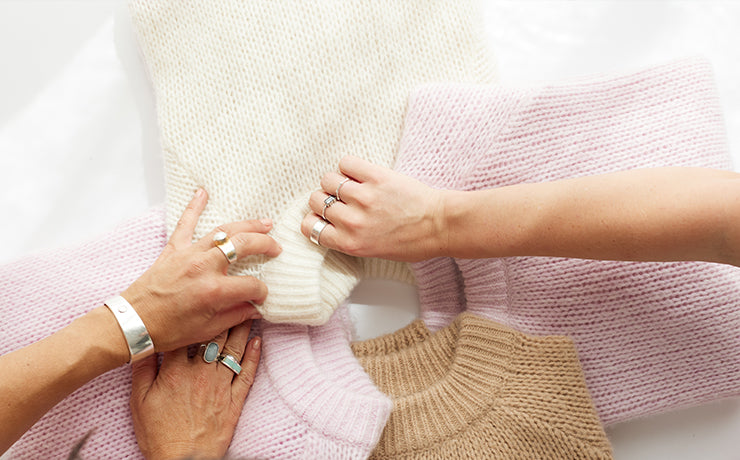
Handy Care Tips.
So you’ve splashed out and bought a new cashmere jumper and the time has come to launder or de-pill. Eeik... fear sets in. Don’t panic. We want to help you keep your cashmere fresh for as long as possible. So here’s how to care for your garment properly and invests in a happy future for your cashmere.

How often should I wash my cashmere?
There is a common misconception that cashmere is too delicate to be laundered too often - thats wrong. Cashmere is made by spinning the finest of fibres together to create 2 plys of twisted strands of yarn. The soft downy surface of the sweater easily catches day to day dust, and perspiration. Therefore by not washing your cashmere you will actually speed up the ageing process. We recommend you clean your cashmere at least once a season, or more often if you are are an avid wearer.


How to wash.
Always read the care label for your sweater. Not all cashmere knit constructions can be laundered the same way, so check.
• Always use an approved delicates detergent. As an alternative, a baby shampoo is the next best thing.
• Turn your knit inside out before washing to avoid the outer surface being accidentally rubbed up.
• Wash only in cool or lukewarm water - hot water will cause shrinkage and damage to the knit.
• Avoid fabric softeners as these can clog up the fibres leaving the sweater feeling greasy.
• Don’t rub the fabric against itself, it can cause the matting of the fibres and increase pilling.
• Do not wring out your sweater – this will stretch it out of shape.
• Remove excess water by rolling on a towel, or carefully use the spin cycle of a washing machine for about 5 mins.
• Pull the garment back into shape, especially if the sleeves have become twisted or stretched.
Dont let it dry whilst its still stretched or distorted.
• Then lay it flat in the shade - not in direct sunlight.
Some cashmere garments with a stable knit structure can be carefully laundered in a washing machine. However, make sure you always check with the manufacturer first to get their instructions.
As a general rule, if you do wash a cashmere garment in a machine, always turn your knit inside out and place it in a washing bag so it is protected from abrasion. Do not agitate longer than 3 mins. And never tumble dry.
Follow the same instructions for drying-
• Remove excess water using the spin cycle.
• Pull the garment back into shape.
• Then lay it flat in the shade.

How to dry.
A tip to help dry your cashmere is to lay it flat on a towel then roll both of them into a tube. Lightly apply pressure to the tube, to allow the towel to absorb any leftover water.
Post-roll, lay your cashmere flat on a smooth flat smooth surface with a towel underneath it to dry completely. If pressing is required, use a warm iron with a protective cloth and press inside out.


De-pilling.
All cashmere will pill. Pilling is a natural characteristic of even the finest cashmere which is why we give a free cashmere comb with all our sweaters.
Pilling refers to the little balls that form on a garment where friction occurs. It is part of the life cycle of well-loved cashmere garments. The occurrence of ‘shedding’ in the first few wears is the natural process of the fibres relaxing out of the twist in the yarn and actually makes your garment softer.
Once you notice balls of pilling forming, lay your garment over a flat surface (an ironing board works well!) then take your cashmere comb and brush in one direction from the top to the bottom of the garment. Dont rub back and forth as this can damage the knit. The goal is to 'pull' the pills off the surface with an even stroke.
If you are not confident to do this yourself, MIA FRATINO offers a bespoke Revitalise Treatment which includes washing, de-pilling and pressing to bring your garment back to life.


Always fold flat.
Some people don’t realise that hanging any knit knit on a hanger is a really bad idea.
The weight of the knit causes the hanger to push into the shoulder area, leaving awful stretch marks and distortions. This is why you should always store your cashmere folded.
For end-of-season storage, use a storage bag that can be sealed to keep moths and silverfish away from your precious knit.
Add a natural repellant like Sandalwood bars in your wardrobe for an additional level of protection. This will prevent any nasties trying to nibble on your natural fibre.
IMPORTANT - Always wash your garments before stowing them away at the end of the season. The natural oils of our body are trapped when we wear a knit, and this attracts unwanted insects.

Sandalwood Moth Repellent.
Made from essential oils and sandalwood, the herbal scent from our Sandalwood bar will remain powerful for months. Its a natural and chemical-free way to repel moths from your beautiful cashmere, silk and merino garments.
Hang this sandalwood bar in your cupboard to subtly perfume and freshen your clothing while naturally repelling insects.
The better you care for your Cashmere, the longer it will bring you pleasure.

If you find moth holes.
A dreaded moth infestation requires one thing: an all-out closet quarantine.
Remove everything made from natural fibres and separate away from other items. Moths adore protein fibres like cashmere and merino.
Clean the inside of the closets and spray affected areas with bug spray.
PRO TIP: Put all your cashmere, silk and merino from your cupboard in the freezer for at least 48 hours. This will freeze and kill the larvae. This is the most effective step to break the cycle. Its the strategy we use at our Mia Fratino Care centre.
Then wash all your garments. But here is where the heartbreak begins.
Moths lay their eggs and fly away. It's the unseen baby larvae that quietly eat your garments.
Its in the act of washing that all the damage becomes apparent. The water loosens the knit around the unseen holes which then seem to burst out of nowhere. This can be pure heartbreak.
Storing your garment in a protective bag once winter has ended is a valuable habit. Peak moth season is mid-Springtime into Summer. So if you see a moth in your cupboard as the weather warms, its probably too late.
If you discover a moth misfortune – or find any other snag or hole in a garment, there is an option.
Mia Fratino offers a simple repair service as part of our sustainability ethos. Its our way of helping customers save their precious garments from going to the landfill.
Follow this link to see if we can save your knit. Repair Service
MORE TO EXPLORE

Shop All Knitwear

Find a Stockist